Showing posts with label econ tutorial. Show all posts

24 Aug 2016 . Wed . 9am . Econ : Tuiorial

Case Study

The condominium price at 2013 was RM 300k in township, but 2 year later it is increase by 30%. Kindly explain the issue in term of inflation, what are the cause and what are the solution to reduce inflation?

Answer

What is Inflation
  • general increase of price in the basket of goods  
  • CPI consumer Produce Index.

Cause / Issues of Inflation

 Cost push and demand pull

Goverment ( Cost Push inflation )
  • 6% GST 
  • Policy


Developer ( Cost Push )
  •  production of cost material
  • high labor cost - minimum wages
  • increase in raw material
  • increase the demand in the township

Buyer ( Demand pull )
  • increase population
  • high demand low supply
  • worry about 6% GST  


Natural ( Cost push )
  •  Land shortage
  •  


Demand-Pull Inflation and Cost-Push Inflation. Both types of inflation cause an increase in the overall price level within an economy


Remedies to reduce inflation

Fiscal policy
tax - increase tax - impose tax RPGT
gov spending - reduce

monetery policy ( expand or contract )
money supply - central bank - hard to control
interst rate - increase the rate - saving and borrowing

direct measure
subsidies price of certain product
during CNY / Raya


Solutions
  1. Build the satelite township


Characteristic of money and types of monetary policy


durabiliyt
portabality
diversibility - smaller notes, match the value
 scarcity -

(stick to the note will give you good answer )

type
contractionary - increase the
expansionary - reduce interste rate , easy to borrow and spend money, print more money

(stick to the note will give you good answer )


Unemployment can be caused by many reasons, kindly explain
  • effects of the unemployment in the different aspects
  • measures to reduce the unemployment rate

 defination of unemployment

2 effect - social and economic effect

social - increase the crime rate
economic -

measure to reduce the unemployment rate
fiscal policy - implement program

direct measurement
increase job vacancy
own business
(stick to the note will give you good answer )

Kindly explain motives of money demand, what is the roles of Federal Reserve Bank in USA?

Motive of money demand
money demand
precautionary demand
speculative motive demand

role
issue notes /
manage payment
debot
supervise
transfer
resou
reserve
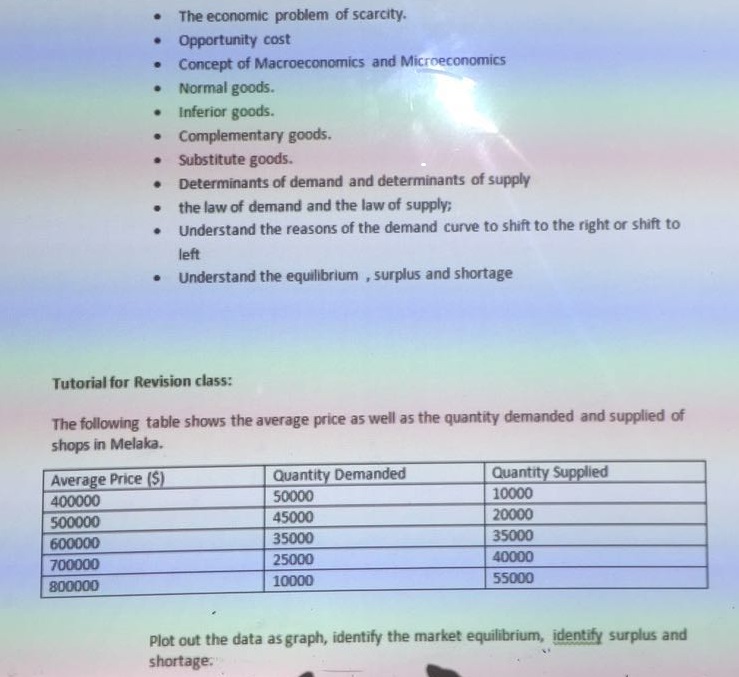
29 June 2016, 900am, Wednesday. Economic : Test - answer

Give the definition

  1. the economic problems of scarify -  key word must be in the answer : limited resource, unlimited wants
  2. opportunity cost - key word must be in the answer : forgone
  3. concept of macroeconomic and microeconomics - key word must be in the answer : as a whole, GDP,
  4. normal goods key - word must be in the answer :
  5. inferior goods - key word must be in the answer : income
  6. complementary goods - key word must be in the answer
  7. substitute goods - key word must be in the answer
  8. determinants of demand and determinant of supply - key word must be in the answer
  9. the law of demand and the law of supply - key word must be in the answer
  10. understand the reasons of the demand curve to start to the right or start to left -
  11. understand the equilibrium, surplus and shortage. - key word must be in the answer

 Answer
  1. the economic problems of scarify - Scarcity refers to the basic economic problem, the gap between limited – that is, scarce – resources and theoretically limitless wants. This situation requires people to make decisions about how to allocate resources efficiently, in order to satisfy basic needs and as many additional wants at possible. Any resource that has a non-zero cost to consume is scarce to some degree, but what matters in practice is relative scarcity.  Also referred to as "paucity."
  2.  opportunity cost -An opportunity cost is the cost of an alternative that must be forgone in order to pursue a certain action. Put another way, the benefits you could have received by taking an alternative action.

  3. concept of macroeconomic and microeconomics - Microeconomics is the study of decisions that people and businesses make regarding the allocation of resources and prices of goods and services. This means also taking into account taxes and regulations created by governments. Microeconomics focuses on supply and demand and other forces that determine the price levels seen in the economy. For example, microeconomics would look at how a specific company could maximize its production and capacity so it could lower prices and better compete in its industry. Macroeconomics, on the other hand, is the field of economics that studies the behavior of the economy as a whole and not just on specific companies, but entire industries and economies. This looks at economy-wide phenomena, such as Gross National Product (GDP) and how it is affected by changes in unemployment, national income, rate of growth, and price levels. For example, macroeconomics would look at how an increase/decrease in net exports would affect a nation's capital account or how GDP would be affected by unemployment rate.

  4. normal goods -
    An economic term used to describe the quantity demanded for a particular good or service as a result of a change in the given level of income. A normal good is one that experiences an increase in demand as the real income of an individual or economy increases.
    Another way to define a normal good is by calculating its income elasticity of demand. If this coefficient is positive and lower than 1, the good is considered to be a normal good.

  5. Inferior goods - An inferior good is a type of good for which demand declines as the level of income or real GDP in the economy increases. This occurs when a good has more costly substitutes that see an increase in demand as the society's economy improves. An inferior good is the opposite of a normal good, which experiences an increase in demand along with increases in the income level.

  6. Complementary - material or good whose use is interrelated with the use of an associated or paired good such that a demand for one (tires, for example) generates demand for the other (gasoline, for example). If the price of one good falls and people buy more of it, they will usually buy more of the complementary good also whether or not its price also falls. Similarly, if the price of one good rises and reduces its demand, it may reduce the demand for the paired good as well. Also called complementary product. Goods that come together with another goods.

  7.  substitute goods - "substitute good" in economics and consumer theory is a product or service that a consumer sees as the same or similar to another product. In the formal language of economics, X and Y are substitutes if the demand for X increases when the price of Y increases, or if there is a positive cross elasticity of demand. Replacement good

  8. determinants of demand and determinant of supply - The determinants of individual demand of a particular good, service or commodity refer to all the factors that determine the quantity demanded of an individual or household for the particular commodity. The main determinants of demand are price, taste, preference. 
    Determinants of supply (also known as factors affecting supply) are the factors which influence the quantity of a product or service supplied. We have already learned that price is a major factor affecting the willingness and ability to supply. Here we will discuss the determinants of supply other than price. These are the factors which are assumed to be constant in law of supply.
    The price change of a product causes the price-quantity combination to move along the supply curve. However when the other determinants change, the supply curve is shifted.
    Following are the major determinants of supply other than price: number of seller, price of resources, tax and subsidies, technology,
  9. Law of demand states that other things being equal, the demand for a product is inversely proportional to the price of the product. In other words, the demand is higher at lower prices and lower at higher prices under the assumption of ceteris paribus (i.e. other things being equal). The other-things-being-equal assumption is very important in law of demand because the demand for goods also varies with many factors other than price. The law of demand simplifies the price-demand relationship by assuming that all other demand-affecting factors are constant.
    We can easily find many examples of economic behavior demonstrating the law of demand. For example, we are likely to buy more oranges if the price per dozen is $3 and less if the price per dozen is $6.
    The following graph shows the relation between price and quantity demanded for hypothetical buyer http://xplaind.com/388810/law-of-demand
    According to the law of supply, there is a direct relationship between supply and the price of a product or service under cetirus peribus assumption (i.e. other things being equal). Law of supply states that the quantity of a product or resource made available for sale by a producer or a resource owner varies directly with the price of the product or resource respectively provided that other things remain constant.
    It is important to note that supply is affected by a number factors in addition to price and the law of supply applies only under the assumption that other things remain constant.
    There are lots of examples of economic behavior which is in conformance to the law of supply. For example, a fruit vendor will try to make available more fuits for sale when the fruit prices prices are high and relatively less when the prices are low.
    The law of suppy can be presented in the form of a graph between the price and the quantity supplies of a product as shown below: http://xplaind.com/117257/law-of-supply
  10. Determinants of demand (also called factors affecting demand) are the factors which cause the demand curve to shift. A change in any of the determinants of demand will cause the demand to change even if the price remains fixed. Major determinants of demand are income, taste, price and expectation. http://xplaind.com/502380/determinants-of-demand  
    Determinants of supply (also known as factors affecting supply) are the factors which influence the quantity of a product or service supplied. We have already learned that price is a major factor affecting the willingness and ability to supply. Here we will discuss the determinants of supply other than price. These are the factors which are assumed to be constant in law of supply.
    The price change of a product causes the price-quantity combination to move along the supply curve. However when the other determinants change, the supply curve is shifted.
    Following are the major determinants of supply other than price number of seller, price of resources, tax and subsidies, technology and supplier expectation.
  11. Sometimes the market is not in equilibrium-that is quantity supplied doesn't equal quantity demanded.  When this occurs there is either excess supply or excess demand.

    A Market Surplus occurs when there is excess supply- that is quantity supplied is greater than quantity demanded.  In this situation, some producers won't be able to sell all their goods.  This will induce them to lower their price to make their product more appealing.  In order to stay competitive many firms will lower their prices thus lowering the market price for the product.  In response to the lower price, consumers will increase their quantity demanded, moving the market toward an equilibrium price and quantity.  In this situation, excess supply has exerted downward pressure on the price of the product.

    A Market Shortage occurs when there is excess demand- that is quantity demanded is greater than quantity supplied.  In this situation, consumers won't be able to buy as much of a good as they would like.  In response to the demand of the consumers, producers will raise both the price of their product and the quantity they are willing to supply.  The increase in price will be too much for some consumers and they will no longer demand the product.  Meanwhile the increased quantity of available product will satisfy other consumers.  Eventually equilibrium will be reached. 
Equilibrium is a state of rest or balance due to the equal action of opposing forces. In terms of Economics, Equilibrium Price is the price toward which the invisible hand drives the market. At this point, the upward and downward pressure on price is equal and the quantity demanded equals the quantity supplied. The market mechanism naturally present in most markets consists of these counterbalancing pressures. Equilibrium can occur in all types of markets, but the commonly assumed model for its occurrence is the perfectly competitive market. When a market is in equilibrium, there is no excess supply or excess demand.  Equilibrium quantity is the amount bought and sold at the equilibrium price.http://www.econport.org/content/handbook/Equilibrium.html


29 June 2016, 900am, Wednesday. Economic : Test


Give the definition
  1. the economic problems of scarify
  2. opportunity cost
  3. concept of macroeconomic and microeconomics
  4. normal goods
  5. inferior goods
  6. complementary goods
  7. substitute goods
  8. determinants of demand and determinant of supply
  9. the law of demand and the law of supply
  10. understand the reasons of the demand curve to start to the right or start to left
  11. understand the equilibrium, surplus and shortage.


15 June 2016, Wednesday, 11am. Economic Tuitorial 4

Draw out the organization structure in your company, explain the pros and cons of the structure.


Answer

This hierarchical structure is following the layout of pyramid

Advantages
1.     Level of leadership within the chart, authority and responsibility is obvious
2.     Negotiator narrow their field of focus and become the experts like Sub Sale and Project
3.     Opportunities for promotion motivate the negotiator to perform well
4.     Negotiator become more loyal when have higher position 

Disadvantages
1.     Communication between higher and lower level is tends to be less effective
2.     Own department will make decision that benefit its own interest rather than whole organization.
3.     Feedback, decision making and respond time will be longer among the since have to go through so many level.
4.     Cost is higher when by each level is increasing

8 June 2016, Wednesday. Economic Tuitorial 3


Tutorial 3:
Based on a real estate agency, kindly elaborate the factors of Input and output within the agency.
Input example: Land , labour/human resource, capital, entrepreneur.
Output example: Goods and services produced.

1 June 2016, Wednesday. Economic Tuitorial 2